

You can add the following welding symbols according to the dedicated standard.


Complementary symbols
You can add the following contour symbols according to the dedicated standard.
| Name | AWS | ISO | JIS |
| Concave face |
 |
|
|
| Convex face |
 |
|
|
| Fillet weld with smooth blended face | NA |
 |
NA |
| Flat face |
 |
|
|
| Flush finished | NA |
 |
NA |
Finish symbols
You can add the following finish symbols according to the dedicated
standard.
| Name | AWS | ISO | JIS |
| C |
 |
|
|
| F |
 |
|
|
| G |
 |
|
|
| H |
 |
|
|
| M |
 |
|
|
| R |
 |
|
|
| U |
 |
|
|
 |
Field weld |
 |
Weld-all-around |

 |
Weld text side (up or down) |

 |
Indent line side (up or down) |
 |
Weld tail |
 |
Alternative welding staggered display |
 |
Reference |


-
Click the Welding Symbol icon
 from the Annotations toolbar (Symbols sub-toolbar).
 -
Select one or two elements defining the weld to determine the position of the leader anchor point.

Double reference selection is available only if the first selected element is a 2D geometry. 
You can press the Alt key to orient the annotation in the vertical direction. 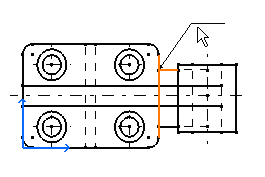
-
Move the pointer to position the welding symbol and then click at the required location.
The annotation can be snapped in horizontal and vertical directions, or along the bisector of the angle between the two reference elements. -
In the Welding symbol dialog box, select the direction for the Weld text side
and the Indent line side
.- In the case of a drafting view associative to a weld specification originally defined in the Weld Design app, this dialog box is pre-filled in accordance with the 3D specification. The welding symbol is created associatively to the 3D specification. In this case, the parameters in the dialog box cannot be modified.
- The Indent line side
is available only when the
welding symbol display System-A is selected in the
welding parameters of ISO standard.
-
Enter the values in the required boxes.
- When you specify the size of weld and length of weld, a new box appears above it for additional information.
- The engineering symbols can be inserted in all the boxes except the box below plug symbol.
-
Select the required welding symbol, complementary symbol and finish symbol.
- The welding symbols are available depending on the selected standard.
- When an elementary or a supplementary symbol is selected, another pair of these symbols appear above them.
- When the plug weld symbol is selected, a box appears below it.
- The staggered (Z) symbol is displayed in the welding symbol annotation only if a text is entered next to the staggered symbol.
- In the Welding Symbol
dialog box, the staggered symbol appears based on the welding
staggered display parameter selected in the
Standard Definition dialog
box. For more information, see
Welding.
- Usual: To display the staggered (Z) symbol in the welding symbol annotation.
- Alternative:
To offset the weld symbol on the opposite side of
the reference line. Click the
Alternative welding staggered
display
to activate the alternative welding staggered
symbol.
-
Add complementary indications like a field weld, weld-all-around, or a weld tail.
-
Click Import file to import a text file.
-
Click Reset to clear all the values.
-
Click OK.
The welding symbol is created.
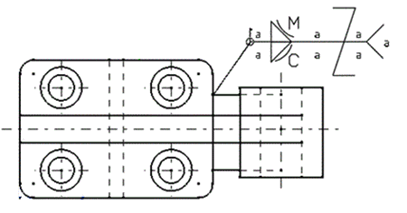
The values entered in the dialog box are saved as user preference for next usage. -
If needed, modify the welding symbol position by dragging it to the required location.
-
Double-click the welding symbol to edit it. For example, click the Weld text side
to change the side of the text.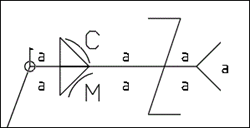
- If you have selected the Use style values to create new objects
option in Tools> Options> Mechanical Design> Drafting>
Administration tab, the Welding creation dialog box is pre-filled
with custom style values (as defined in the Standards Editor). In this
case, Properties toolbars and the Tools Palette are disabled during the
creation of the welding symbol.
On the other hand, if you have not selected this option, the Welding creation dialog box is pre-filled with the last entered values (if any). In this case, Properties toolbars and the Tools Palette are active during the creation of the welding symbol. - You can reset the current style values in the Welding creation dialog box at any time using the Reset button.
- You can close the tail (reference) using a rectangle variable-size
frame
 . For more
information about adding frames, refer to
Adding Frames or Sub-Frames.
. For more
information about adding frames, refer to
Adding Frames or Sub-Frames. - At any time, you can modify the welding symbol. To do this, double-click the welding symbol to be modified and enter the modifications in the displayed dialog box.
- You can import a plain text file (.txt) to use as a reference (specification, process or other) by clicking the Import File button.
- The welding symbol is automatically updated when the drawing standard is switched. For example, from JIS to ISO. During the switch, if a welding symbol is unavailable in the target standard, it is replaced by an underscore.
