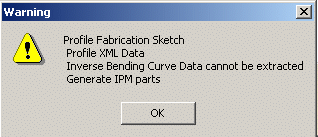
Important: You must have already generated the in-process model (IPM). Otherwise, you cannot extract data and you will get a warning message.
Extract Inverse Bending Curve Data

-
Click Workshop Documents Extraction
 .
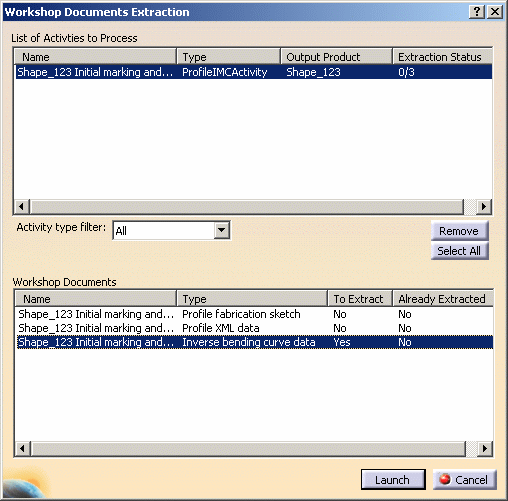
.The Workshop Documents Extraction dialog box appears. -
In the PPR tree, select an initial marking and cutting activity of the shell shape for which you want to extract inverse bending curve data.
The selected activity is shown in the top half of the dialog box. -
Select the activity.
All associated workshop documents are listed in the bottom half of the dialog box. -
Click the To Extract column to indicate whether or not you want to extract the associated document:
Clicking this column switches the value from Yes to No and vice-versa.
Set the To Extract column to Yes to extract inverse bending curve data only.
-
Click Launch when done.
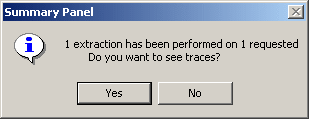
Request file is generated and saved in the location identified in the project resource management (PRM) file (by default, workshop documents are saved in C:\temp, see Managing Project Resources). .A dialog box appears summarizing the process and indicating how successful or not it has been.
-
Click No to continue if the extraction was successful or Yes to see traces if needed.
-
Open the inverse bending curve data file you have just created.
When generating inverse bending curve (IBC) data, the command also generates and saves an XSL file at the same location as the XML file containing IBC data. This file contains a stylesheet to present IBC data in tabular form. 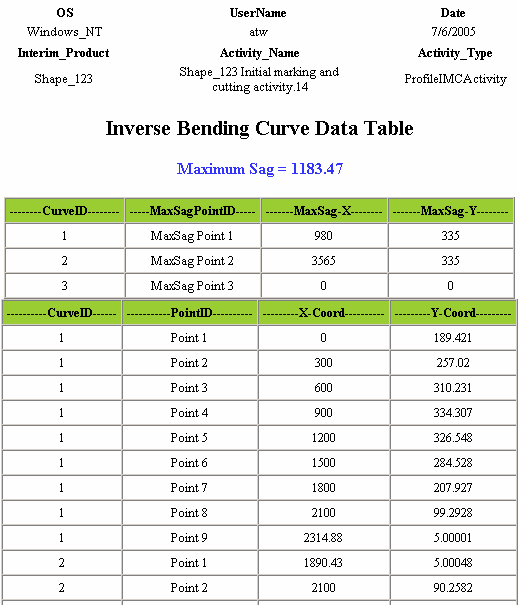
Extract Plate Distortion Data
-
Click Workshop Documents Extraction
.The Workshop Documents Extraction dialog box appears. -
In the PPR tree, select the plate formation activity that includes the curve on which you have created plate distortion data.
The selected activity is shown in the top half of the dialog box. -
Select the activity.
All associated workshop documents are listed in the bottom half of the dialog box. -
Click the To Extract column to indicate whether or not you want to extract the associated document:
Clicking this column switches the value from Yes to No and vice-versa.
-
Set the To Extract column to Yes to extract plate distortion data only and click Launch when done.
The requested file is generated and saved in the location identified in the project resource management (PRM) file (by default, workshop documents are saved in C:\temp. See Managing Project Resources). .A dialog box appears summarizing the process and indicating how successful it has been.
-
Click No to continue if the extraction was successful or Yes to see traces if needed.
-
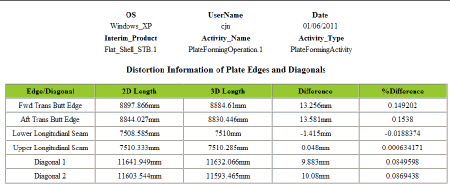
Open the plate distortion XML data file you have just created.
When generating plate distortion data, the command also generates and saves an XSL file at the same location as the XML file containing data. This file contains a stylesheet to present IBC data in tabular form.