
To access the contextual part of the assembly, you can refer to the links of the corresponding document and retrieve the context used for defining the contextual link. The reconciliator first analyses the assembly loaded in CATIA session and then recursively follows inter-document links, to get a list of documents comprising the assembly.
A CATPart which depends on another CATPart having
External References is considered as a contextual part. The behavior
depends on the context of the contextual part, particularly, if the
context is loaded in CATIA session before reconciliation.
Note: In some cases, the reconciliator automatically loads some
document.
Exposed Context
The diagram below illustrates the dependency of the PRC document between
Part1 and Part2 for exposed context. This dependency is defined in an
assembly and will establish reference to instances used for
definition and is referred to as context.
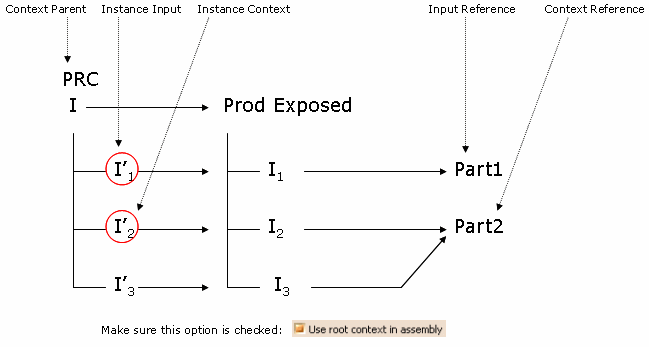
Here Part2 is contextual to Part1.
When you select Use root context in assembly, Part1 is
pointing to both I’1 and I’2.
Workpackage Context
The diagram below illustrates the persistence of the link in Part2.CATPart
document for workpackage context. This link is retrieved when
reconciliator analyzes the current assembly.
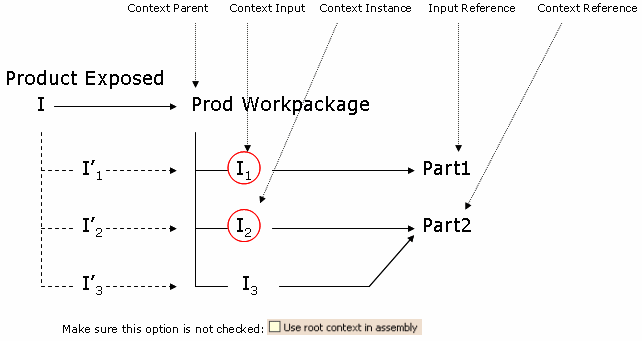
Here Part2 is Contextual to Part1.
When Use root context in assembly is deselected, Part1 is
pointing to both I1 and I2.
By default, a contextual part already loaded in memory will not load the context document in memory.
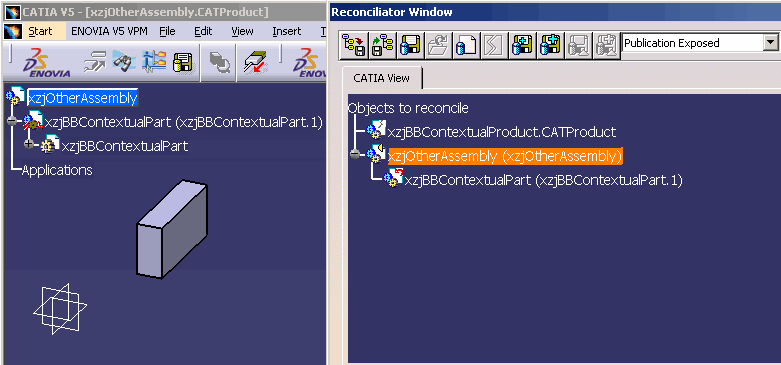
Note: The context document kept at its original location with its original name is said to be reachable whereas if the context document is renamed or moved, the contextual part is not reachable.
If you
use the contextual part
outside its context (where context is reachable), a warning message appears in Reporting
dialog box. This message analyzes the situation and explains about the
rule
restriction in the reconciliation session.
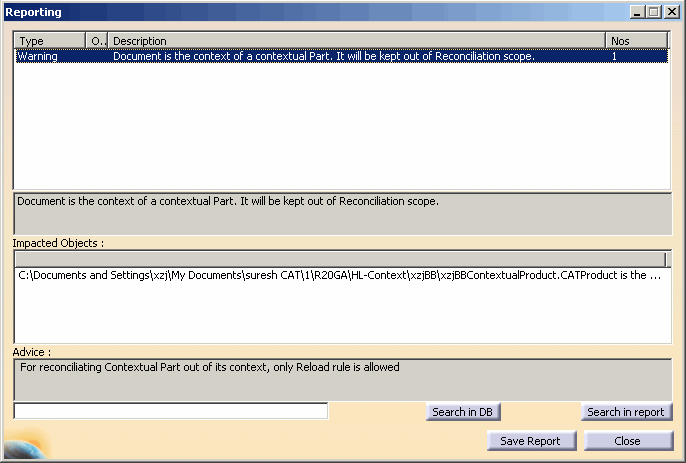
If Reload rules are already enforced on the context, (possible if the context was previously saved as WorkPackage (Publications Exposed) in the database), then there is no restriction on the contextual part reconciliation rule.
Other Assembly:
Aggregating the contextual CATPart (out of its context) and context already loaded in session (eg: other windows of CATIA)
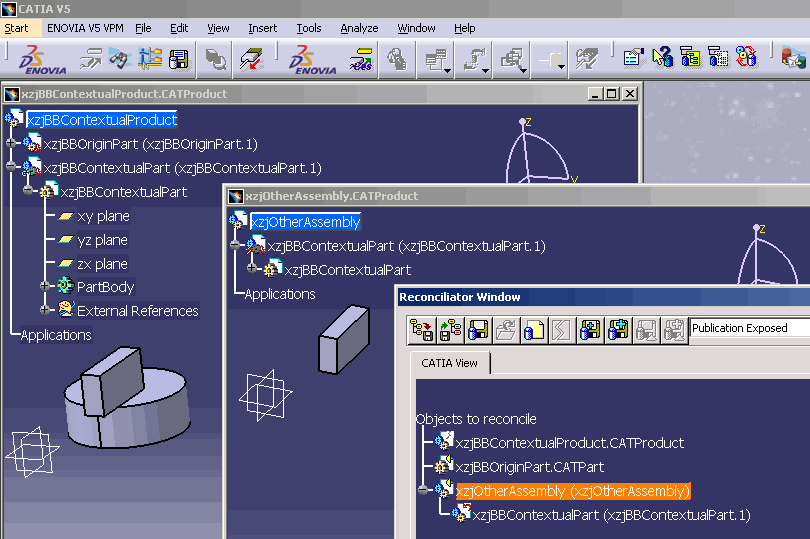
If you
use other assembly, aggregating the contextual
CATPart (out of its context); and the context
(where context is reachable) is already loaded
in session (example: other windows of CATIA), a
warning message appears in Reporting
dialog box.
Even when the context is loaded, the context
is excluded from the reconcile session by managing it as a Proxy on
which keepAsExternal rule is
applied.
- The Reload rule must be applied for contextual parts having their context out of the current assembly.
- The contextual part must be saved initially in the assembly used for defining the contextual links, while executing FDBI.
- You must update the context irrespective of the rule selected. For structure exposed, the contextual parts are relative to PRC while the contextual mode do not support a mixed structure (both structure and Publication Exposed)
- Reconciliation of StandAlone Contextual CATPart is not supported.
