
This test lets you check analysis free vibrations results for a compressor blade in the context of a modal (or frequency) case. You will use 2D meshes.

Reference:
- OLSON,M.D.,LINDBERG,G.M., Vibration analysis of cantilevered curved plates using a new cylindrical shell finite element, 2nd Conf. Matrix Methods in Structural Mechanics, WPAFB, Ohio 1968.
- OLSON,M.D.,LINDBERG,G.M., Dynamic analysis of shallow shells with a doubly curved triangular finite element, JSV, Vol. 19, No 3, pp 299-318, 1971.
 Specifications
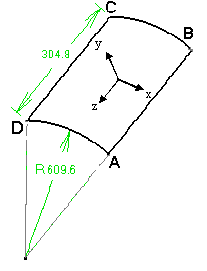
Geometry Specifications
|
Length: |
|
|
Radius: |
|
|
Thickness: |
|
|
Angle: |
Analysis Specifications
|
Young Modulus (material): |
|
|
Poisson's Ratio (material): |
|
|
Density: ρ = 7857.2 Kg/m3 |
|
|
Mesh Specifications: |
|
|
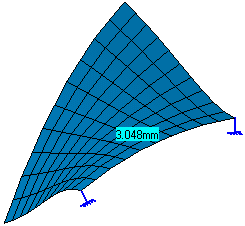
Restraints: |
|
 Results
The table below presents the frequencies of the first six modes (mesh specifications: 11 x 11 nodes).
|
Mode |
Reference value |
Computed value [Hz] |
|||
|
Linear triangle |
Parabolic triangle |
Linear quadrangle |
Parabolic quadrangle |
||
|
|
|
|
|
||
|
1 |
85.6 |
87.68 |
85.34 |
84.10 |
85.90 |
|
2 |
134.6 |
143.05 |
138.2 |
136.3 |
138.6 |
|
3 |
259.0 |
251.3 |
246.4 |
252.4 |
246.1 |
|
4 |
351.0 |
349.6 |
339.8 |
338.0 |
341.3 |
|
5 |
395.0 |
394.4 |
383.3 |
382.5 |
384.1 |
|
6 |
531.0 |
544.0 |
527.9 |
547.3 |
528.8 |


To Perform the Test:
The Free_vibrations_compressor_blade_QD8.CATAnalysis document presents a complete analysis of this case, computed with a mesh formed of parabolic and quadrangular elements (QD8).
To compute the case with linear quadrangle (QD4), linear triangle (TR3) and parabolic triangle (TR6) elements, proceed as follow:
-
Open the CATAnalysis document.
-
In the Advanced Meshing Tools workbench, replace the mesh specifications as indicated above.
-
In the Generative Structural Analysis workbench, compute the case.
