
The following topics are discussed:
Flex Physical Simulation Overview
Flex Physical Simulation is a physics-based realistic cable solver that allows you to simulate the behavior of cables using integrated CAD-CAE tools during the product design process.
Components such as flexible tubes, hoses, wires, and electrical wires permit deformation; they are very flexible so that their shape adapts to the context in which they are used. This behavior is taken into account in design and simulation processes through Flex cable solver

Flex Definition
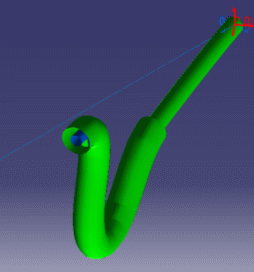
A flexible slender body (flex) is constituted of a 3D curve/line called neutral fiber and a variable cross-section.
Example of a variable cross-section:
 |
Cross-sections
Sections are two-dimensional views of slices through objects. Only orthotropic cross-sections are supported by Flex. An orthotropic cross-section has two symmetry planes; the shear section has to fit with the centroid of the section. The table below illustrates the various orthotropic cross-section types:
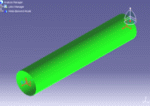 circular cross-section |
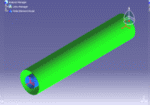 annular cross-section |
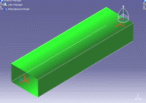 rectangular cross-section |
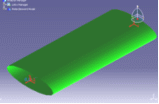 arbitrary orthotropic cross-section (elliptic) |
Material properties
Flex Physical Simulation cable solver permits specific local deformation modes (Flexible Behavior) for the flex:
- traction-compression mode (in axial direction)
- torsion mode (around axial direction)
- bending-shearing mode (in orthogonal planes containing axial direction)
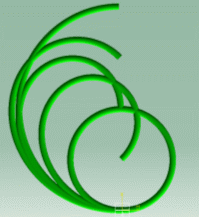
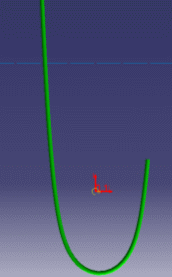
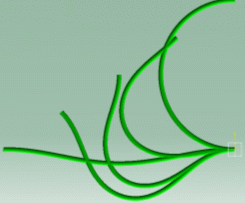
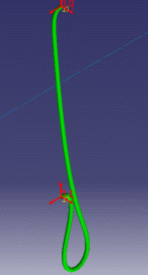
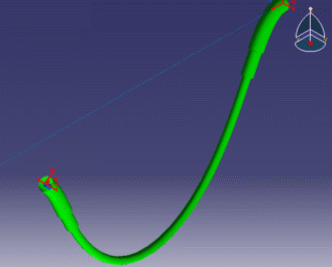
Examples of more or less flexible flex cables subjected to gravity and imposed displacements at their extremities:
 |
|
 |
 |
 |
FLEX Added Values
Flex cable solver allows you to model and simulate the realistic behavior of flexible cables (material and geometric properties).
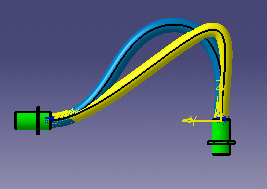
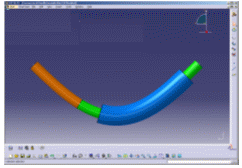
Flex cable solver provides you with a strong realistic picture of the cable behavior as shown in this example below. In yellow, the standard solver is used. In blue, Flex solver is used.
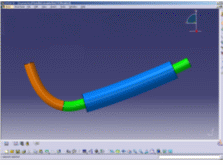
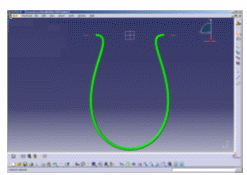
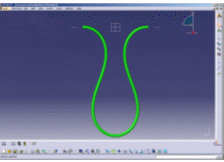
Electrical Harness Simulation and Flex Dynamic Cable Simulation 2 (FDS)Flex Dynamic Cable Simulation 2 (FDS) is a variant of the Flex Physical Simulation product. This physics-based realistic cable solver not only supports a physically realistic cable simulation, but also includes penetration avoidance between the cable and other parts. Electrical Harness Simulation can benefit from Flex Dynamic Cable physics-based realistic cable solver for penetration avoidance purposes. Integrated with Electrical Harness Simulation product, Flex Dynamic Cable Simulation supports penetration avoidance between cables and obstacles for 3D elements. |
|
 |
Flex Dynamic Cable Simulation 2 (FDS) does not support penetration avoidance for 1D wireframe elements, and only in some cases for 2D shells (depending on the shell orientation). |
